Lessons from Jimmy Buffett’s Estate: Why the Right Trustee Matters
Choosing a Trustee: Estate-Planning Lessons From Jimmy Buffett’s Estate
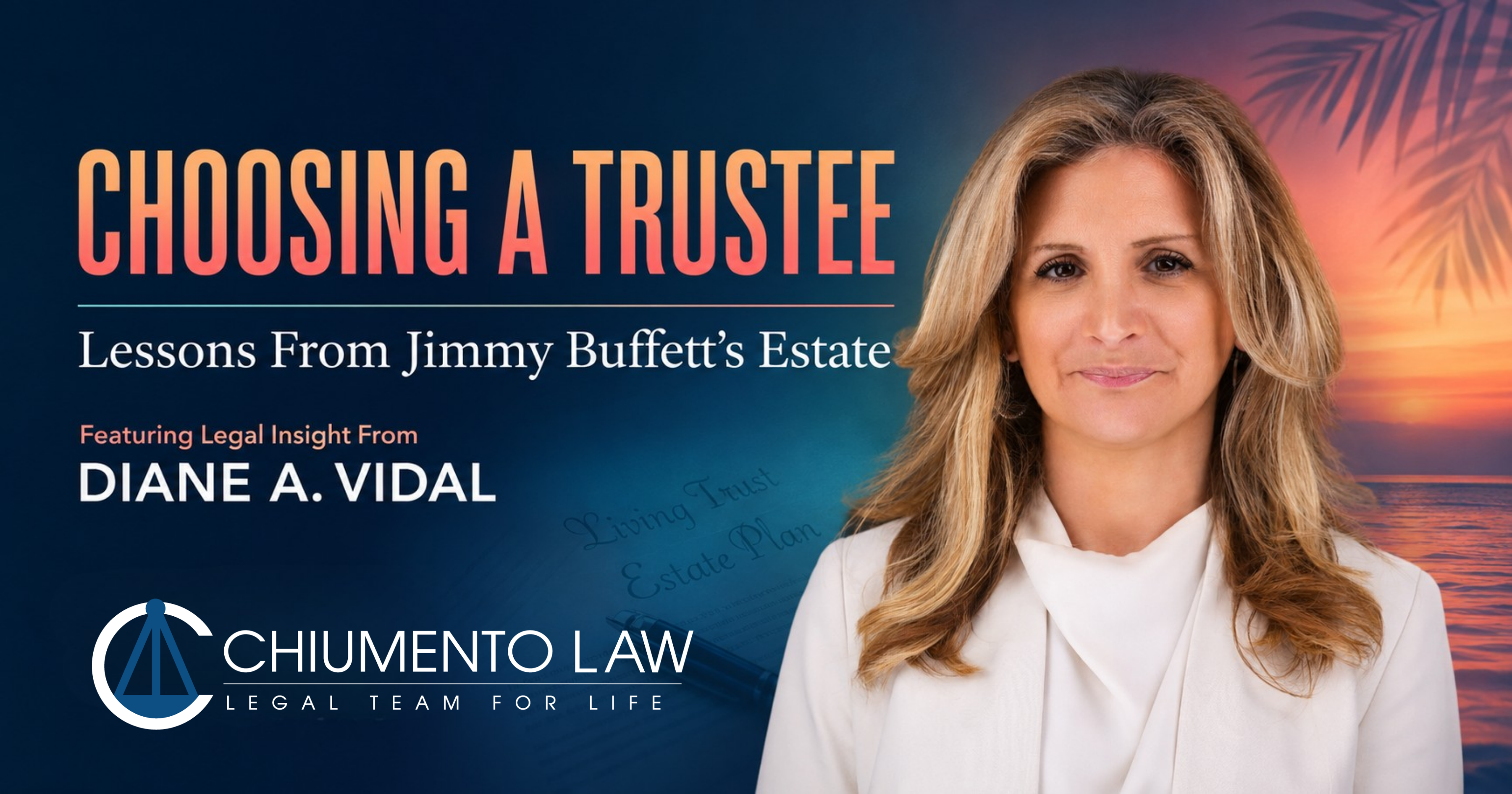
When creating an estate plan, people often focus on who will inherit their assets. However, choosing a trustee to manage those assets and carry out their wishes is equally important.
Attorney Diane A. Vidal, a Partner and estate-planning attorney at Chiumento Law, recently contributed legal insight to Florida Trend. She was featured in its September 2026 article, “Wastin’ Away,” written by Mike Vogel.
The Florida Trend article examines the trust dispute involving the estate of legendary musician and businessman Jimmy Buffett. The dispute provides an important estate-planning lesson about choosing a trustee, especially when a trust names two people to serve together.
Buffett named his wife of more than four decades, Jane Buffett, and his longtime friend and business adviser as co-trustees. The resulting disagreement illustrates the complications that may arise when two people must share control of a trust.
What Are the Potential Problems With Co-Trustees?
Naming co-trustees may seem like a good way to provide balance, oversight and additional protection. In practice, however, the arrangement can sometimes lead to conflict, delays or deadlock.
Even routine decisions can become difficult when trustees have different priorities or communication styles. They may also interpret the terms of the trust differently. These disagreements can delay distributions, increase administrative expenses and potentially result in court involvement.
The situation may become even more complicated when one trustee is also the surviving spouse and primary beneficiary of the trust.
As Diane explained in the Florida Trend article, a surviving spouse is already coping with the emotional impact of losing a husband or wife. After a long marriage, restrictions on the spouse’s ability to manage financial matters may create additional uncertainty or “culture shock.”
Why Does the Person’s Intent Matter in a Trust Dispute?
When a trust dispute reaches the courtroom, the court must review the trust’s terms and consider the intent of the person who created it.
A beneficiary’s disagreement with a trustee may not be enough to have that trustee removed. Depending on the trust’s provisions and applicable law, removal may require evidence of misconduct, a breach of fiduciary duty or another legally recognized basis.
This is one reason thoughtful estate planning is so important. A trust should do more than state who will receive the assets. It should also create a practical structure for managing those assets and resolving disagreements.
How Should You Choose a Trustee for Your Estate Plan?
Choosing a trustee for your estate plan requires careful consideration. The person or institution selected may be responsible for managing assets, communicating with beneficiaries and following the terms of the trust for many years.
Before naming one or more trustees, consider the following questions:
- Are the proposed trustees capable of working together?
- What will happen if the trustees disagree?
- Could requiring joint decisions create unnecessary delays?
- Does the surviving spouse understand the proposed arrangement?
- Is there a clear process for resolving a deadlock?
- Does the trust explain how a trustee may be replaced?
- Could an independent trustee create more complications than protection?
There is no single trustee arrangement that is right for every family. The appropriate structure depends on the family relationships, the complexity of the assets and the client’s long-term goals.
However, the possible consequences of naming co-trustees should be carefully considered before the estate-planning documents are finalized.
Estate Planning Goes Beyond Drafting Documents
The dispute involving Jimmy Buffett’s trust offers a valuable lesson for families at every financial level. Estate planning is not simply about preparing documents. It is also about anticipating how those documents will work in real life, potentially many years after they are signed.
An experienced estate-planning attorney can help identify possible conflicts and create a structure that reflects the client’s intentions. Careful planning may also reduce confusion, delays and preventable disputes among family members.
Diane’s contribution to Florida Trend reflects the practical approach she brings to her estate-planning practice at Chiumento Law. She looks beyond the documents to identify potential problems, protect each client’s intentions and help families avoid preventable conflict.
To learn more, read “Wastin’ Away” in the September 2026 edition of Florida Trend.
Speak With an Estate-Planning Attorney
If you are creating or reviewing an estate plan, the Estate Planning team at Chiumento Law can help you choose a trustee and develop a plan that protects your wishes and works for the people you love.
Contact Chiumento Law to schedule a consultation with a member of our Estate Planning team.
Chiumento Law
Your Legal Team for Life Since 1973
This article is provided for general informational purposes only and does not constitute legal advice. Every estate-planning situation is different. Consult a qualified attorney regarding your individual circumstances.
About the Author

Diane A. Vidal has been practicing law since 2007 and concentrates on civil litigation, including landlord/tenant disputes, contract negotiation, tort actions, and equitable claims. She also works in real estate law. She graduated with honors from Rutgers University with a Bachelor of Arts in criminal justice and graduated cum laude from Seton Hall University of Law. She is passionate about helping her community members understand the American legal system, and is licensed to practice in Florida, New York and New Jersey. She received the New Jersey Super Lawyer, Rising Star award for five years in a row. Ms. Vidal is fluent in Portuguese and is a member of the Portuguese Club of Palm Coast.